Combined Reporting Groups in WA
How WA explorers legally pool spend across tenements (and avoid forfeiture)

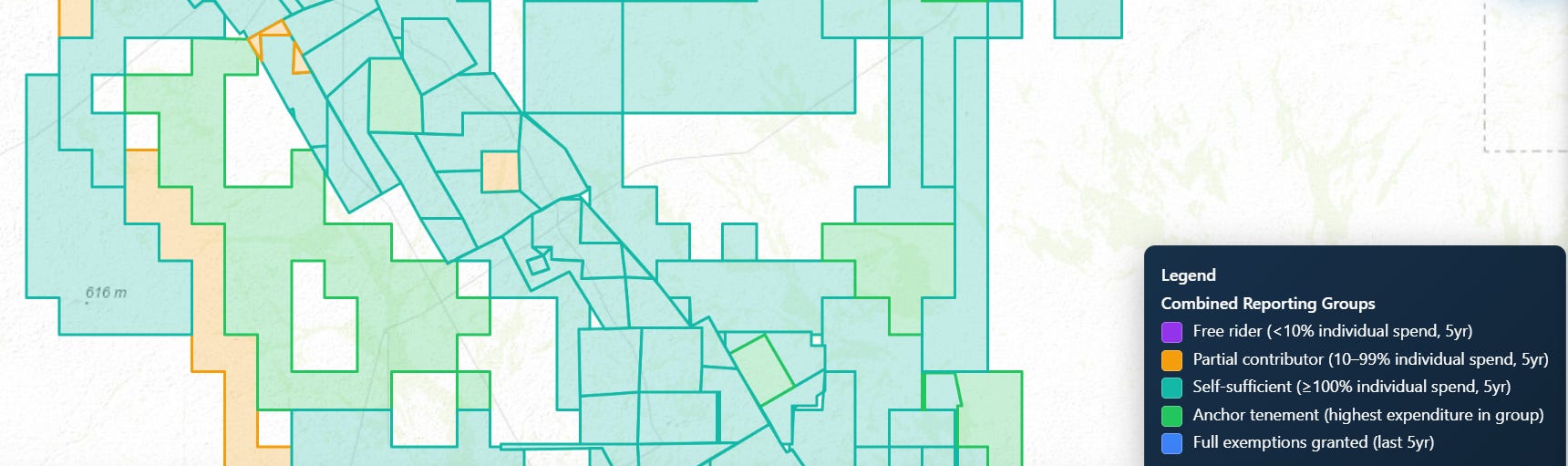
If you’re running a multi-tenement exploration project in WA, you’ve almost certainly hit this scenario: you’ve drilled hard on your best licences, overspent on two of them, and undercooked expenditure on the others. Now the anniversary is coming up and you’re staring at a compliance problem.
This is exactly what combined reporting groups are designed for, but they only work if you’ve set them up correctly and apply for exemptions on time. Here’s how it all fits together.
What Is a Combined Reporting Group?
Combined Reporting Group (CRG) is a formal arrangement under section 115A of the Mining Act 1978 (WA) that allows contiguous tenements with a common project to be reported together. It’s not automatic, you must apply to DMIRS and receive Ministerial approval.
CRGs are designed primarily for exploration and prospecting licences (E and P), where annual minimum expenditure conditions apply. Mining Leases (M) sit largely outside the grouping framework, although some MLs do carry prescribed expenditure conditions in their own right (early-stage, suspended, or special-purpose MLs in particular).
To qualify, the tenements need to:
Be contiguous or nearly contiguous
Share a common geological target or project
Have the same holder or operator
Have all overdue Form 5s lodged and up to date before the application
Once approved, the group is assigned a common anniversary date. You’ll lodge a single combined exploration narrative on that date, but every tenement in the group still needs its own individual Form 5 (Operations Report) each year. Combined reporting doesn’t replace the Form 5 obligation; it just allows you to seek exemptions based on the group’s pooled expenditure.
How Expenditure Pooling Works
Here’s the key mechanism. Under section 102(2)(h) of the Mining Act and Regulation 58A, if the group’s aggregate exploration expenditure meets or exceeds the sum of all individual tenement commitments, you can apply for an exemption certificate (Form 18) for any tenement that fell short.
In plain terms:
Combined Minimum Expenditure = sum of each tenement’s annual commitment
Group Aggregate Spend = sum of each tenement’s reported exploration expenditure
If Group Spend ≥ Combined Minimum, you have grounds to seek exemption for under-spent tenements.
A Worked Example
Say you hold three exploration licences with annual commitments of $100k, $150k and $200k, a combined obligation of $450k. In a given year:
Tenement | Commitment | Reported Spend | Position
---------|------------|----------------|----------
A        | $100,000   | $80,000        | –$20,000
B        | $150,000   | $180,000       | +$30,000
C        | $200,000   | $190,000       | –$10,000
Total    | $450,000   | $450,000       | Neutral
Tenements A and C individually fall short, but the group total meets $450k exactly. You can apply for Form 18 exemptions on A and C under s.102(2)(h), citing the aggregate spend against the combined commitment. DMPE will consider whether the aggregate criterion is satisfied, and if it is, exemptions are typically granted.
What Counts as “Exploration Expenditure”?
This is where most operators trip up. Combined group expenditure isn’t an exemption category, it’s an allocation mechanism. It can only allocate eligible exploration spend, and it doesn’t widen the definition of what counts.
The case law
Two cases define where the line sits. In GMK Exploration Pty Ltd v Big Bell Gold Operations [2016] WAMW 14, the Warden’s Court took a narrow view, only direct mineral exploration activities count toward the aggregate, excluding administration costs, land rent, and overheads. The WA Supreme Court took a broader approach in Brewer v O’Sullivan (No 2) [2017] WASC 269, holding that costs “in connection with exploration” can include Aboriginal heritage surveys, land rent, and certain overheads, not just drilling and sampling. Brewer is the more authoritative statement of the current law.
Mining costs are out, regardless of which case you’re working under
Even under the broader Brewer interpretation, mining and production costs are firmly excluded. They were never the question, and they don’t become eligible exploration spend simply because they happen on a tenement that also carries an expenditure condition.
The following don’t count toward your combined group aggregate:
Ore extraction, haulage, and processing
Crushing, screening, and beneficiation
Plant construction and operation
Stockpiling, blending, and product transport
Mine workforce and production labour
Royalties and production-related compliance costs
What does count:
Drilling (RC, diamond, aircore)
Geological mapping and sampling
Geophysics and geochemistry
Pre-production assaying and metallurgical test work
Field logistics directly supporting exploration
Data interpretation and Form 5 reporting
Environmental and heritage surveys required to enable exploration
A useful heuristic comes from how wardens approach borderline costs: would the activity still be undertaken if no mining were occurring? If yes, it’s likely eligible. If no, it’s almost certainly out.
The MTO trap
If you’re pulling expenditure figures off MTO to build your aggregate, watch the bottom of the page. Mining Activities are summed separately and should never be pulled into a combined group expenditure calculation. It’s an easy mistake when you’re working from screenshots or copy-pasting figures, and wardens see it often enough to be unsympathetic.
Don’t pad the aggregate
The practical implication: don’t lump project overhead into your Form 5 aggregate to reach the threshold. Ensure every dollar you’re relying on for a combined-group exemption is a legitimate exploration cost, and keep documentation that supports each line item. DMPE has the power to audit Form 5 claims independently, and if the audited figure falls short of your declared spend, your exemption basis evaporates. Wardens regularly:
Disallow mining or production costs
Treat their inclusion as a compliance error or an attempt to inflate the aggregate
Reduce credited expenditure, sometimes turning what looked like a comfortable aggregate into a material shortfall
Grant only partial exemption, or refuse outright where the shortfall is material
No carry-forward
There is no mechanism to carry overspend forward into future years. Each year’s obligation is independent, surplus spend in Year 1 cannot offset a shortfall in Year 2. Exemptions are assessed annually, and must be applied for annually.
The Form 18 Application, and Why the 60-Day Deadline Is Non-Negotiable
Expenditure shortfalls don’t automatically trigger forfeiture, but only if you seek exemption on time. The application must be lodged using Form 18 within 60 days after the tenement’s anniversary date.
Miss that window and you lose the right to apply, regardless of how much the group overspent. Wardens have been consistently unsympathetic to late applications, and DMIRS will initiate forfeiture proceedings for non-compliance.
A Form 18 application for a combined-group shortfall needs to:
Cite section 102(2)(h) as the grounds
Include a statutory declaration of aggregate spend across the group (as required by Regulation 54)
List each tenement’s individual commitment and reported spend
Show the group total meets or exceeds the combined minimum
There is no prescribed formula for how costs are apportioned across tenements within the group, DMPE and the courts want to see actual incurred expenditure, not arithmetic allocations by area or some other proxy.
Other Valid Exemption Grounds
Section 102(2)(h) isn’t the only route. If a tenement individually has reasons for underspending that are independent of the group, other subsections may apply:
(a) Title under dispute
(b) Time needed to evaluate results or raise capital
(c) Time required to erect plant or machinery
(d) Mining not possible due to ground conditions
(j) Other sufficient reason
These apply at the individual tenement level and don’t require combined group status. In practice, many compliance situations involve a mix, some tenements covered by the group aggregate, others with their own site-specific reasons.
Enforcement Is Getting Stricter
Recent decisions from WA Wardens and the Supreme Court have reinforced that:
Combined group status is not a free pass, tenement obligations remain tenement-specific
Meeting individual minimums does not bar you from applying for s.102(2)(h) exemptions (a point confirmed in Supreme Court proceedings involving major explorers)
Even minor non-compliance can trigger forfeiture applications, DMPE has been taking a harder line in recent years
Current holders can be held liable for past breaches if a tenement was transferred with outstanding compliance failures, so buy-side diligence matters
One particularly important point: if you voluntarily surrender or sell a tenement from a combined group, the remaining group should be reconstituted and any pending compliance issues resolved before transfer.
The Compliance Workflow
Here’s the process in practice:
Before you start exploring: Identify your tenement package and check contiguity. If combined reporting makes sense, apply early, before the first Form 5 is due.
During the year: Track expenditure by project and by tenement. Use actual cost codes, not estimates. Keep exploration cost centres separate from any mining or production cost centres, especially if you’re transitioning from one to the other on the same ground.
At year end: Calculate each tenement’s position against its commitment. Strip out any production-related costs before you total the aggregate. If the eligible aggregate meets the combined minimum, begin preparing Form 18 applications for any shortfalls.
Within 60 days of anniversary: Lodge Form 5s for every tenement. Lodge Form 18s (with statutory declarations and evidence) for any under-spent tenements.
After lodgement: If DMIRS requests an audit of any Form 5, cooperate fully and provide underlying documentation. Update your records once exemptions are granted or refused.
If refused: Seek legal advice and consider whether an appeal to the Warden’s Court is warranted. Act quickly, sitting on a refused exemption with a compliance gap is the fastest path to forfeiture.
Keeping Track Across a Large Package
If you’re managing more than a handful of tenements, tracking individual obligations against eligible spend each year is genuinely complex. Expenditure commitments escalate, reporting dates vary, and the interaction between combined group status, individual Form 5 obligations, and the exploration/mining cost split creates real administrative overhead.
NextMaps tracks expenditure compliance across the entire WA tenement register using DASC EMITS data, giving you visibility over which tenements are trending underspent relative to their obligations before the 60-day window closes. If you’re doing due diligence on a tenement package, or trying to prioritise where to allocate exploration budget, the Expenditure Compliance layer gives you the picture at a glance.
This post is general information only. The WA Mining Act and related case law are complex, seek qualified legal advice before making compliance decisions on your tenements.